Putting On a New Roof? Build It FORTIFIED — Before Monsoon Season Tests It
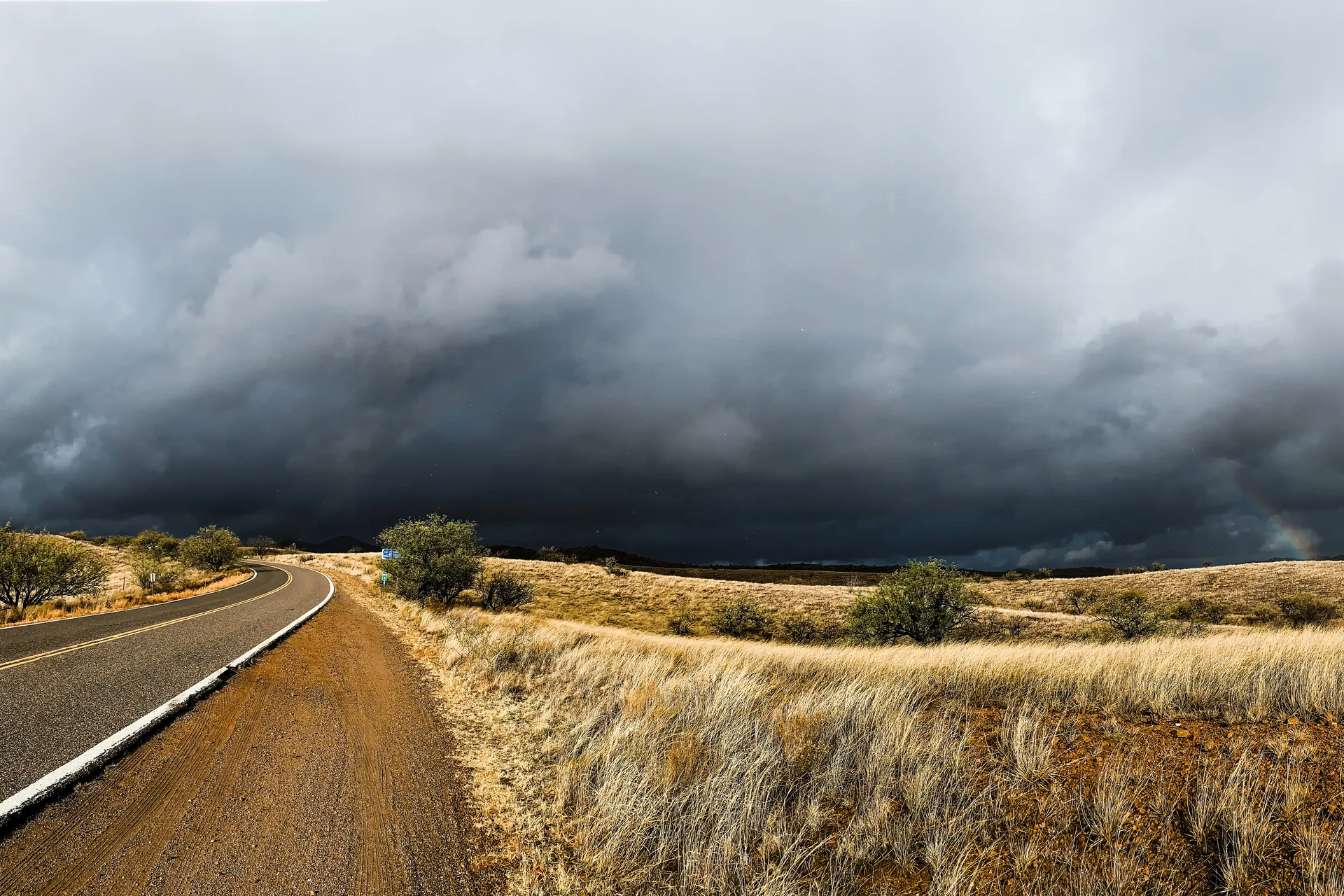
Storm clouds gather over a winding road and dry grassland.
If you're putting on a new roof, consider renovating to FORTIFIED standards. That's advice we share a lot, and it deserves more than a Facebook post — because if you're already paying for a roof replacement, the strongest version of that roof costs less than most people expect, and monsoon season is not forgiving of the standard version.
Monsoon winds don't care that we don't get hurricanes
FORTIFIED was developed for hurricane country. Don't let that fool you into thinking it isn't for us. A monsoon microburst can slam a neighborhood with winds as strong as a weak hurricane. Haboobs roll in with a wall of wind and debris. Tiles lift, edges peel back, and once wind gets under a roof, it takes the deck with it — and then the rain pours straight in.
Most storm damage we see didn't start with a hole. It started at an edge, or with a deck that wasn't attached well enough, or with water getting in under the covering. That's exactly what FORTIFIED is designed to stop.
What FORTIFIED actually means
FORTIFIED is a construction standard created by the Insurance Institute for Business & Home Safety (IBHS), a nonprofit research organization that tests how homes actually fail in storms — with real wind and rain, at full scale — and writes standards to fix those failures.
The three levels:
FORTIFIED Roof — the roof itself, built and verified to the stronger standard. This is the level for a re-roof.
FORTIFIED Home–Silver — FORTIFIED Roof, plus stronger protection for windows, doors, and openings.
FORTIFIED Home–Gold — the whole home, roof to foundation, as one connected system.
For most Surprise and West Valley homeowners, FORTIFIED Roof is the practical one — the moment to do it is when the old roof is already coming off.
What makes a FORTIFIED Roof different
From the street, it looks like any other roof. The differences are underneath:
A sealed roof deck. The deck seams are sealed and a waterproof underlayment system keeps rain out even if the outer covering blows off. Per IBHS, a sealed roof deck reduces water intrusion by roughly 95% — and water, not wind, is what turns a roof claim into a gutted kitchen.
Ring-shank nails. The deck is attached with ring-shank nails instead of smooth nails that pull out under pressure. They grip the wood and roughly double the deck's resistance to lifting off.
Enhanced edge details. Roof edges are where wind gets its grip, so FORTIFIED requires stronger drip edges and a secured starter course.
None of this is exotic — it's better materials and a better method on a job your roofer is already doing, and then proving it.
What it costs — and what you might save
Building to FORTIFIED Roof standards typically costs about 6–16% more than a standard roof replacement, depending on your roof's size and pitch. That's a real number — but it's a fraction of what a full water-intrusion loss costs in damage, displacement, and deductible.
Many insurers also offer a discount on the wind portion of a homeowners premium for a certified FORTIFIED home. How much — and whether your carrier offers one — varies by carrier and by policy, so we won't quote a percentage here that we can't promise. What we can do is check your specific policy before you sign a roofing contract, so you know where you stand.
How certification works
You can't just take a roofer's word for it — that's the point. A FORTIFIED Roof has to be verified by a certified FORTIFIED evaluator, who documents the materials and installation as the work happens. That documentation earns the certificate, and it's what an insurer will ask to see.
Certification is valid for five years, renewable with a re-inspection. Bring the evaluator in before the work starts, not after — the sealed deck and nailing can't be verified once they're covered — and keep your certificate with your policy documents.
Is it worth it for your home?
If your roof has years of life left, this is a conversation for later. But if you're getting quotes now, ask each roofer one question: “What would it cost to build this to FORTIFIED Roof standards, with certification?” Then compare real numbers, not guesses. For a home you're staying in — through a lot of monsoon seasons — it's one of the few upgrades that protects the house and can help the premium at the same time.
Getting a roof quote? Talk to us first.
Before you sign, we'll check whether your carrier offers a FORTIFIED discount and what documentation you'll need — so the certification you pay for is the one your policy rewards. As an independent agency, we shop multiple carriers for you.
Get a free quote: Call Moore Insurance Agency at (623) 556-1576, or request a quote through our quote form.
Moore Insurance Agency • 15282 W Brookside Ln Ste 110, Surprise, AZ 85374 • (623) 556-1576